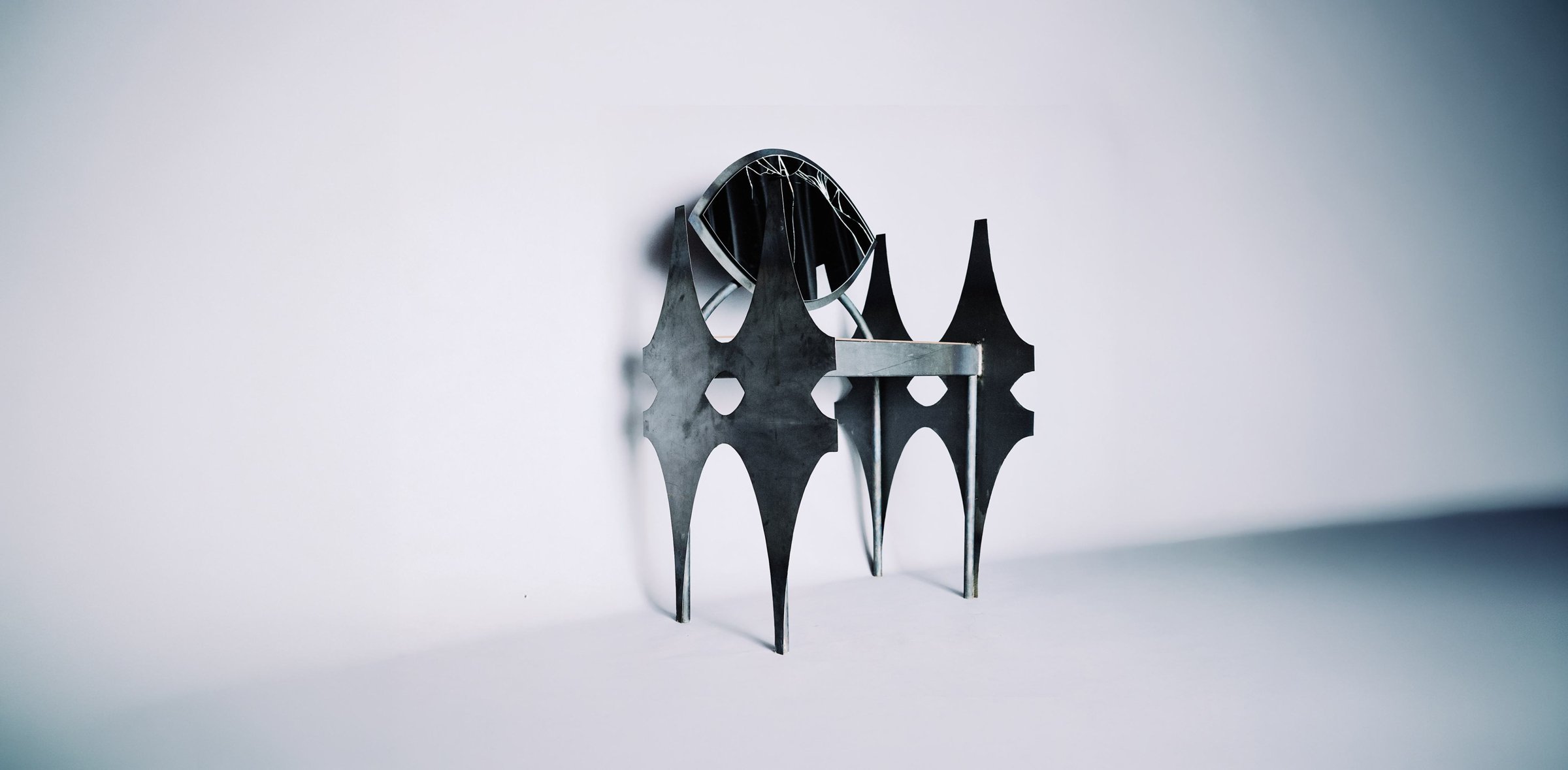
Disposition Vanity
- Duration
- 4 months
- Type
- Industrial Design
A hand-cut, MIG-welded steel vanity designed for Pratt's Metal Tech course, developed through extensive research and prototyping of joint mechanisms to achieve adjustable mirror height and structural stability. The piece draws on Gothic architectural references and the sinuous, organic shapes found in the watercolor stills of “The Belladonna of Sadness” as formal languages. A second rendition is currently in development, commissioned by Isamaya Beauty for a creator campaign.
01Mood board
References: Gothic architecture in London; metal designs blending geometric forms with gothic mystery; The Belladonna of Sadness (dir. Eiichi Yamamoto, 1973); Jean le Noir, Bourgot and workshop, Miniature of Christ's Side Wound and Instruments of the Passion, folio 331r, in the Prayer Book of Bonne of Luxembourg, before 1349. All reference images belong to their respective artists.
02Sketches and development
Hand sketches first, then the forms developed in 3D, from crossed-leg frames and star-shaped mirrors to the gothic side profiles and eye-shaped mirror.
03Design choices
01The apron
A folded, upside-down apron, fabricated as a single piece with four bends, reinforces the 16-gauge steel base and eliminates lateral wobble. Four holes are integrated into the apron for rod attachment.
02Side profiles
The side profiles increase structural rigidity at the leg junctions while referencing a medieval gothic silhouette.
03The mirror
The mirror mounts to the steel base via a concealed wood interface plate, secured with two counter-sunk bolts, enabling tool-free removal.
04The lid
An acrylic lid is attached to the tabletop with hinges.
05Floating mirror
Layered to look like it floats: the mirror is bonded to a smaller wood interface plate, which bolts to the steel plate on the arch with two counter-sunk bolts, all hidden behind the glass.
04Friction hinge mechanism
Two hinge knuckles, welded to the bar and the mirror back, pivot on a 5/16"-18 bolt whose clamping friction lets the mirror tilt and hold at any angle within a limited arc, adjusting for seated eye-line height.
05Process
06Details
Credits
- Metal Tech, Pratt Institute